

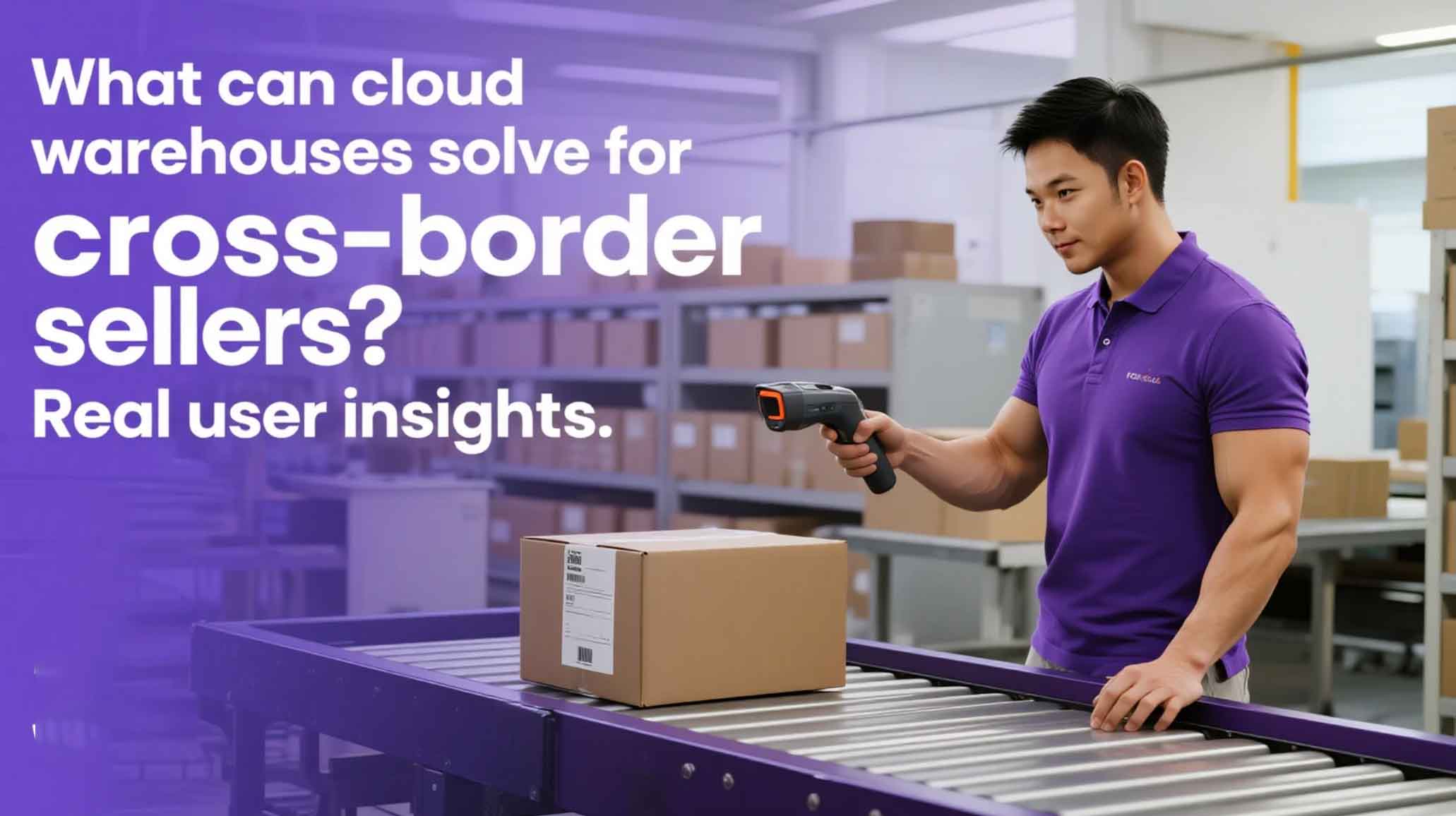
Many domestic sellers choose to package and ship their own products when they first encounter cross-border e-commerce.
When there are not many orders, this method appears to be low-cost and more reassuring. But as the platform increases, orders become scattered, and shipping rules become more complex, problems will gradually emerge. Slow delivery, easy to make mistakes in placing orders, and unclear inventory are not issues of capability, but rather the mode is no longer suitable for the current stage.
Many sellers are truly considering cross-border e-commerce cloud warehouses, often not to save money, but to avoid being held back by trivial matters.
1:Unstable delivery is a common problem for many sellers
Domestic sellers often need to balance product selection, operation, customer service, and logistics during the self delivery stage.
Once orders are concentrated, packaging, labeling, and delivery become sources of pressure. Different e-commerce platforms have different requirements for waybill format, label placement, and timeliness, which can easily lead to deviations in manual operations.
The emergence of cross-border cloud warehouses has precisely separated these repetitive and error prone processes and assigned dedicated personnel to handle them. For sellers, shipping has evolved from a task that must be completed personally to a stable process that can be executed.
2:Unclear inventory is the source of many problems
Many sellers have experienced situations where inventory cannot match. There is still stock on the books, but the system shows that it is out of stock, or it is only discovered that there is still stock in the warehouse after it has been sold out.
In the cross-border cloud warehouse mode, there are system records for inbound, outbound, and inventory changes. Sellers can check inventory status at any time, no longer relying on manual spreadsheets or memory judgments.
When inventory becomes visible in real-time, the replenishment pace and sales planning will also be more relaxed.
3:Time is released, and the focus of operations truly returns to sales
After using cross-border e-commerce cloud warehouses, the most intuitive feeling for sellers is often not the speed, but the change in energy. No need to repeatedly check orders, no need to repeatedly communicate about missing labels, a lot of time is released.
This part of the time is often reinvested into product selection, page optimization, and advertising testing. In the long run, this transformation is more valuable than simply compressing shipping costs.
4:Cloud warehouse services are becoming more refined
The current cross-border cloud warehouse is no longer just about inventory and shipping. From warehouse quality inspection, photo retention, to labeling and order making, to channel matching and abnormal feedback, the granularity of service is becoming increasingly refined.
For sellers who hope to reduce operational risks and improve shipping stability, this service structure is closer to actual needs. Cloud warehouses are no longer a replacement for manual labor, but rather make processes more controllable.
Of course, this does not mean that all sellers need cloud warehouses from the beginning. When there are more sources of orders, significant differences in platform rules, and a decrease in self shipping efficiency, cloud warehouses often become a more suitable choice.
Truly mature cross-border operations often do not take everything into their own hands, but focus their energy on the areas where they should exert the most effort.
SERVICE
Copyright © 2026 TakeSendShip. All rights reserved


