

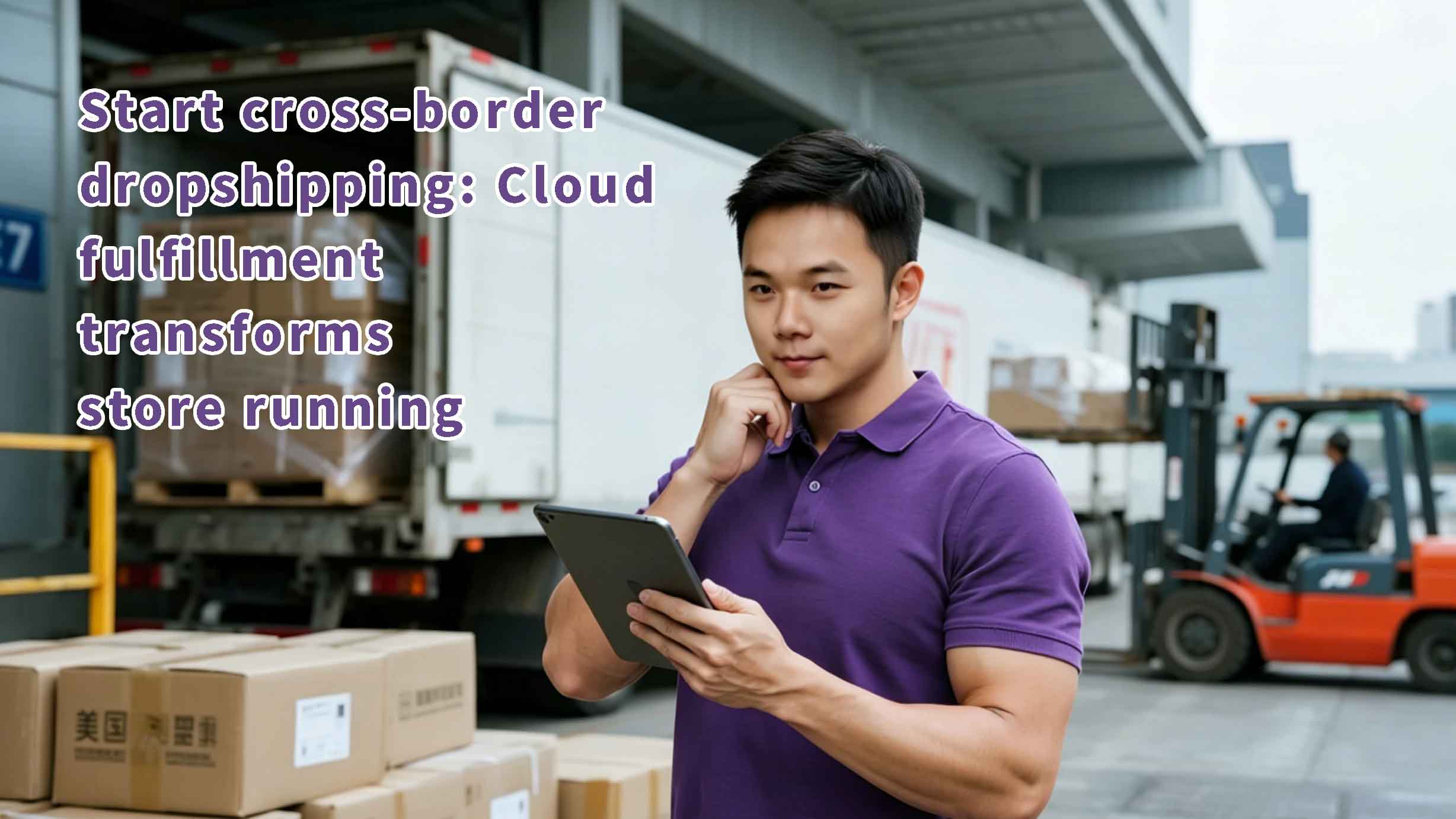
Recently, there has been a frequent issue in cross-border seller communication groups: whether one can still engage in cross-border e-commerce without their own source of goods or warehouse.
This question may have been difficult to answer a few years ago. Because in the past, when doing cross-border business, many people assumed to stock up, rent warehouses, find packaging personnel, and then arrange international logistics for shipment. For teams that are just starting out, inventory investment alone is already a threshold.
But now the way many new stores are launched has changed. Many cross-border sellers do not prepare a large amount of inventory in the early stages of opening a store, but instead rely on the cloud warehouse dropshipping model to focus more on product selection and operation.
For small and medium-sized sellers with limited budgets, the pace of starting a store has also become lighter.
1:The no source mode does not mean there are no products
Many people, when they first encounter cross-border e-commerce without a source of goods, will understand it as having no products to sell.
The true no source mode is closer to light inventory operation. Sellers are responsible for market research, product listing, and order operations, while product warehousing, inventory management, and shipping are completed by the supply chain.
For example, cross-border sellers of household goods can test more than ten SKUs first, without the need to purchase hundreds of items at once.
After the order quantity stabilizes, gradually increase the inventory arrangement. This approach can reduce financial pressure and also mitigate the risks associated with product selection errors.
2:Many new stores are stuck in the shipping process
Many cross-border sellers have had no problem selecting products in the early stage and their store traffic has also improved, but new troubles have arisen as orders begin to grow.
Orders come from different platforms, and different countries require different packaging methods. Packaging, labeling, and shipping are all handled manually. Replying to customers during the day and handling packages at night can easily lead to repetitive work over time.
A seller has shared a situation where the store can handle only a few dozen orders per day, but once it exceeds 100 orders, the warehouse is almost filled with goods. And the problem is not with the order, the shipping capacity cannot keep up.
3:Cloud Warehouse One Piece dropshipping hands over repetitive tasks to the system for processing
After the emergence of cloud warehouse mode, the biggest change is not the shipping speed, but the shipping method.
After the goods enter the storage system in advance, the orders are automatically synchronized, and then sorted, packaged, labeled, and shipped by the warehouse. Cross border sellers do not need to manage inventory themselves, nor do they need to arrange warehouse personnel.
For example, sellers who operate Shopify independent sites and platform stores can consolidate their orders into the cloud warehouse system for processing. Arrange international logistics channels for US orders, and match European orders with another solution.
4:Don't rush to reduce inventory when starting a store
Many beginners tend to make a mistake of thinking that having more inventory is safer. But the core of the no source model is light inventory trial and error.
A product that sells well can gradually increase inventory. A product has average feedback and can be adjusted in a timely manner.
Some cross-border sellers prepare thousands of items at the beginning of their store, but the inventory has not been fully consumed after the product cycle ends. For those who have just entered cross-border e-commerce, the speed of capital flow is often more important than inventory quantity.
5:Cloud warehouses are becoming an important support point for the no source model
The real savings from doing cross-border e-commerce without source of goods are not just warehouse fees. If all the links of warehousing, inventory, shipping, and logistics are built by oneself, it will require a lot of time and effort.
Cloud warehouse dropshipping is more like an operational collaboration node. After the goods enter the warehouse, inventory management, order processing, and foreign trade shipment can be completed, and corresponding international logistics channels can be matched according to different countries.
For small and medium-sized cross-border sellers, the biggest advantage of this model is that they do not have to bear too much cost pressure in the initial stage.
The store can quickly test products in the early stage, flexibly adjust inventory in the middle stage, and gradually expand its operational scale in the later stage.
The truly suitable way for long-term operation is often not to invest the most, but to allow room for adjustment at every step of investment.
In cross-border business, those who run fast may not necessarily win, and those who can continue to run are more likely to see results.
FAQ
Do cross-border e-commerce platforms without a source of goods need to rent their own warehouses?
Many cross-border sellers use the cloud warehouse dropshipping model, which eliminates the need to rent a warehouse to handle foreign trade shipments.
Is cloud warehouse dropshipping suitable for novice sellers?
People with limited budgets or just entering the cross-border e-commerce industry can reduce inventory pressure through cloud warehouses.
How to arrange international logistics shipments under the no source mode?
After the order enters the warehousing system, it can be shipped through the cloud warehouse to connect with international logistics channels.
SERVICE
Copyright © 2026 TakeSendShip. All rights reserved


