

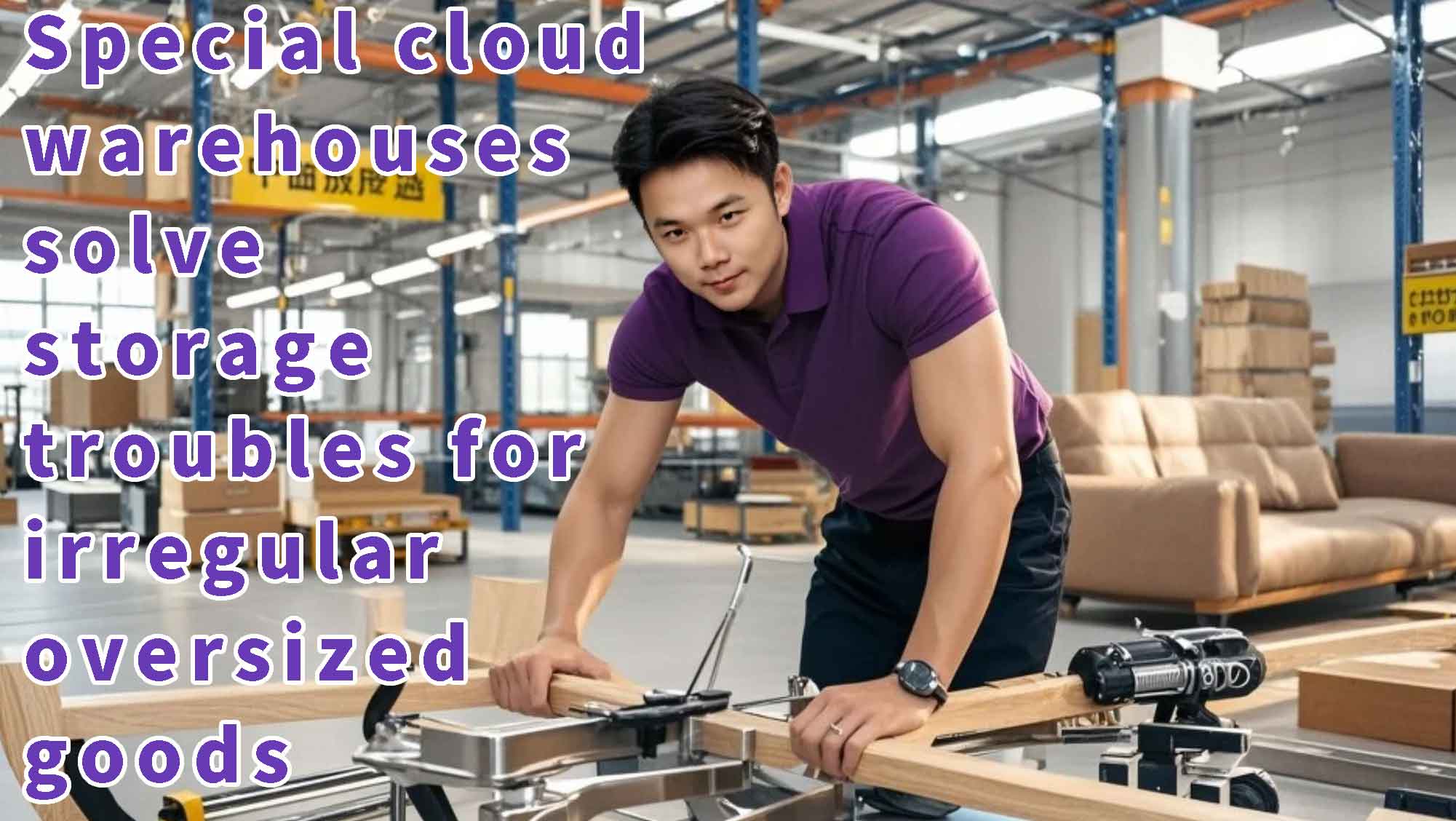
Those who do cross-border business know that standard goods are easy to ship, while non-standard goods are difficult to manage.
After ordinary cardboard products enter the warehouse, there are fixed processes for shelving, storage, and outbound. But when encountering non-standard shaped goods such as large furniture, mechanical equipment, fitness equipment, display props, and engineering accessories, many warehouses are unwilling to accept them.
Some goods are too long, some are too heavy, and some have special packaging shapes. The goods have been produced, but suitable warehouses cannot be found for storage, which has also affected the subsequent shipment plan.
The real problem that many sellers encounter is not the order, but the inability to keep up with the warehousing and shipping processes.
1:Why non-standard shaped goods are easily rejected by warehouses
Most ordinary warehouses are designed around standard goods. The shelf size, storage area, handling equipment, and outbound process are generally applicable to cardboard boxes and standard packaged goods.
Once the size of the goods exceeds the standard specifications, the storage efficiency will decrease. For example, furniture longer than two meters, heavier fitness equipment, and irregularly structured mechanical equipment may all occupy more storage space.
For many warehouses, the same space can store more standard goods, so some warehouses are not willing to store irregular goods for a long time. This is also a common problem encountered by many foreign trade enterprises when looking for warehouses.
2:The difficulty of storing irregular warehouses is not only about occupying space
Many people believe that the problem lies in the inability to store large items. Actually, what's more complex is the follow-up management.
After the goods enter the warehouse, they need to be inspected, registered, photographed, and classified for management. Some project goods need to be shipped in batches, some products need to be palletized, reinforced and packaged, and some goods need to wait for centralized shipment.
If the warehouse lacks corresponding operational experience, the efficiency of outbound operations will be affected. Once the quantity of goods increases, inventory management and shipment management will become more complex.
3:What problems can cross-border dedicated cloud warehouses solve
The biggest difference between cross-border dedicated cloud warehouses and regular warehouses is the ability to manage goods flexibly according to their situation. After the goods are stored, they can be divided into areas according to size, weight, and shipping schedule.
For oversized, oversized, and irregular goods, the warehouse will use corresponding equipment to complete loading, unloading, and storage. At the same time, inventory data is managed uniformly, and the status of goods can be queried in real time.
When customers need to ship, they can arrange for partial delivery, centralized delivery, or project delivery according to the order situation. Cross border trade enterprises that sell a large number of non-standard products find this model more convenient for managing inventory and transportation plans.
4:Warehouse outsourcing is more convenient than temporary shipping
Many companies used to adopt the factory direct shipping model in the past. When there are few orders, it's not a big problem, but as the volume of goods increases, there are often situations such as long delivery preparation times and inconsistent packaging standards.
If the goods enter the cloud warehouse in advance, many tasks can be completed ahead of schedule. For example, inspection, labeling, palletizing, reinforced packaging, and preparation of transportation documents.
After the customer places an order, the warehouse directly arranges for outbound and shipping. Compared to temporary organization of shipments, the warehousing and shipping model is more stable and can reduce the time cost caused by repeated communication.
5:The integrated model from warehousing to shipping is more suitable for large cargo
The transportation of non-standard shaped goods is inherently more complex than that of ordinary products. If warehousing and logistics are handled by different teams, there may be deviations in the information transmission process.
Currently, many cross-border enterprises tend to adopt a collaborative warehousing and shipping model. After the goods enter the warehouse, the subsequent transportation plan is synchronously arranged, and inventory management and shipment management are kept consistent.
In this process, experienced cross-border e-commerce operators will choose cross-border cloud warehouses with experience in managing irregular goods. For example, Taijia Cloud Warehouse can provide services such as storage of irregular goods, temporary storage of goods, palletizing and reinforcement, warehousing outsourcing, and first mile shipping.
For products such as furniture, mechanical equipment, fitness equipment, and engineering project goods, this model can reduce intermediate links and improve overall delivery efficiency.
After the development of cross-border business to a certain stage, warehousing is no longer just about inventory. How to store, manage, and ship goods quickly is often more important than simply searching for a warehouse.
FAQ
Q1: What is non-standard shaped goods?
Goods that are excessively long, wide, overweight, or have special packaging shapes are considered non-standard shaped goods.
Q2: Why are ordinary warehouses unwilling to store irregular goods?
It occupies a large space and requires higher requirements for loading and unloading equipment and warehouse management.
Q3: What services can cross-border cloud warehouses provide?
This includes services such as temporary storage of goods, inventory management, warehousing and shipping, palletizing and reinforcement, and first mile shipping.
SERVICE
Copyright © 2026 TakeSendShip. All rights reserved


