

Many cross-border sellers choose cloud warehouses initially just to find a place to store their goods. After the business gradually stabilized, it was discovered that the real factor affecting shipping efficiency was not the warehouse area, but whether the warehouse management was standardized.
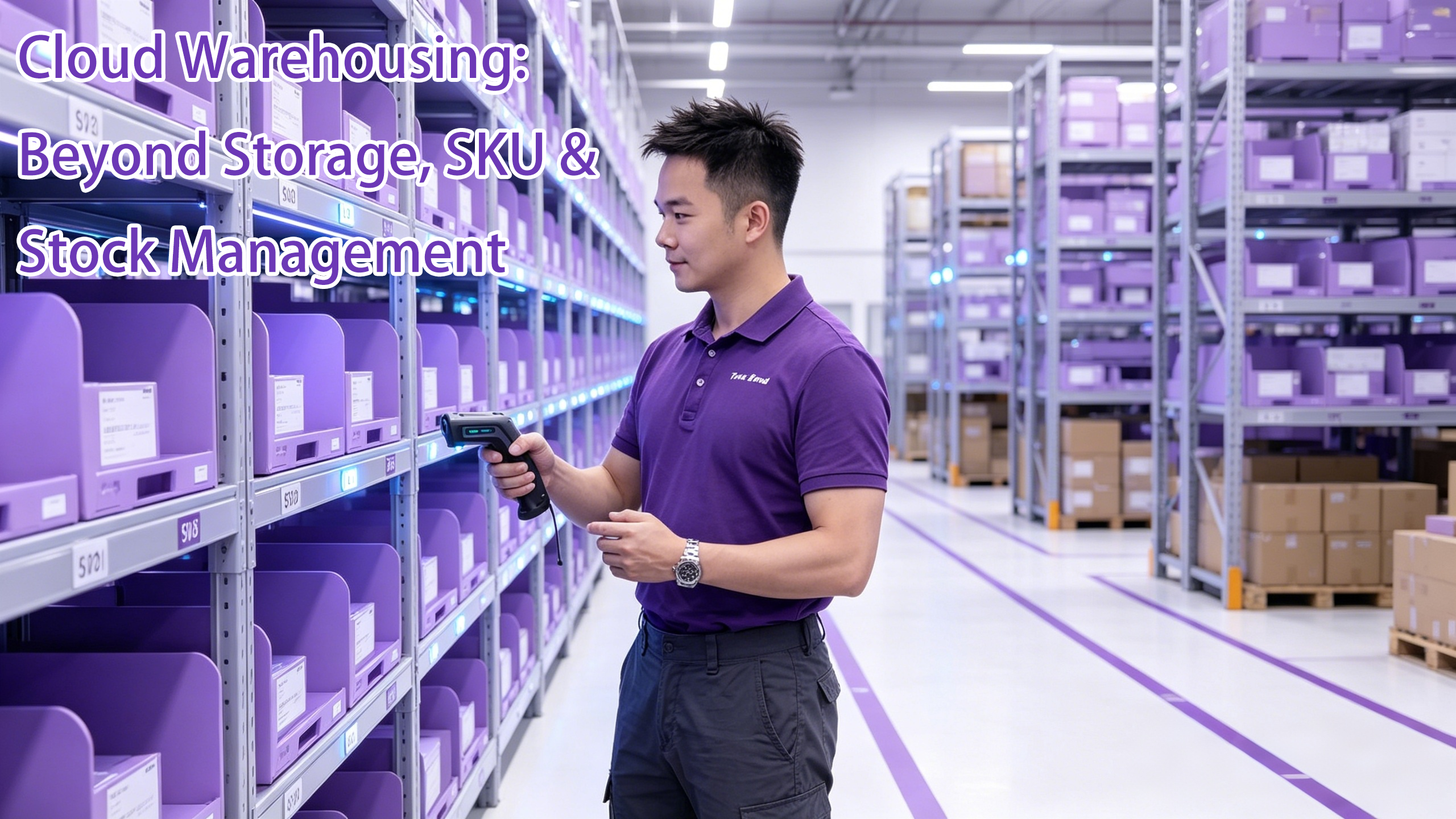
With an increase in SKU quantity, synchronized sales across multiple platforms, and an accelerated replenishment pace, if warehouse management remains at the manual recording stage, problems such as inaccurate inventory, slow sourcing, and inventory errors will gradually arise.
The warehouse not only undertakes the inventory function, but also needs to become the support for inventory management and order fulfillment. Long term stocking, SKU zoning management, and regular inventory have become essential basic services for cross-border cloud warehouses.
1:Long term stockpiling solves the contradiction between stocking and warehouse capacity
Many sellers will arrange large quantities of inventory at once based on the production cycle, but the platform's warehouse capacity is limited, and all goods cannot enter overseas warehouses or FBA warehouses.
Long term storage in cloud warehouses provides a buffer space. After the production of goods is completed, they can be temporarily stored in the warehouse and then shipped in batches according to the sales rhythm. This not only avoids frequent stock adjustments, but also reduces the pressure of inventory being concentrated in the platform warehouse.
For sellers operating on Amazon, independent sites, and multiple platforms, this approach makes it easier to adjust replenishment plans based on market changes and improve inventory turnover efficiency.
2:SKU partition management makes inventory searching more efficient
After the increase in product quantity, many warehouses are not facing a lack of inventory, but rather the inability to find inventory. Mixing different specifications, colors, and models not only affects picking speed, but also easily leads to sending the wrong goods.
SKU partition management categorizes and stores products based on their category, specifications, sales channels, or outbound frequency. Each item has a fixed storage location and corresponding number.
After the order enters the warehouse, the staff can quickly locate the goods, reduce repeated searches and manual judgments, improve outbound efficiency, and also reduce the probability of wrong or missed shipments.
3:Regular inventory is more important than annual chassis inventory
Many companies only conduct inventory checks once every six months or even a year, making it difficult to trace the cause when inventory discrepancies are discovered. Cloud warehouses usually conduct inventory checks on a fixed cycle, checking inventory quantities, location information, and product status.
Adjust inventory data promptly upon discovering anomalies to ensure consistency between system records and actual inventory. Continuous inventory can reduce inventory errors and facilitate sellers to arrange procurement and replenishment in advance.
4:Standardizing warehouse management directly affects the efficiency of order fulfillment
Accurate inventory is just the first step. Order processing, replenishment scheduling, and return management are all based on accurate warehouse data.
The more standardized the warehouse management, the smoother the subsequent order processing. Especially for sellers operating on multiple platforms, unified SKU management and inventory counting can reduce the problem of inventory asynchrony between platforms, allowing the operations team to have a clearer understanding of inventory changes.
5:Integrated warehouse management is more suitable for long-term operation
After the cross-border business enters a stable stage, the warehouse is not only responsible for storing goods. Inventory management, order processing, replenishment transfer, and after-sales product management all require the support of a standardized warehousing system.
For example, in addition to providing warehousing and shipping services, Taijia Cloud Warehouse also supports long-term inventory storage, SKU zoning management, periodic inventory counting, inbound quality inspection, order sorting, and logistics connection services.
After the goods enter the warehouse, classification management rules can be established according to different product attributes, and then outbound can be arranged based on orders and replenishment plans to reduce errors caused by manual management.
FAQ
Q1: Which cross-border sellers are suitable for long-term stockpiling?
Suitable for sellers with long production cycles, need to ship in batches, or limited platform warehouse capacity.
Q2: What are the advantages of SKU partition management?
Easy to quickly locate goods, reduce errors and omissions, and facilitate inventory maintenance and order processing.
Q3: Why do we need to conduct regular inventory checks?
Being able to detect inventory discrepancies in a timely manner, ensuring accurate inventory data, and facilitating subsequent replenishment and operational arrangements.
SERVICE
Copyright © 2026 TakeSendShip. All rights reserved


