

The biggest fear for Amazon sellers is not that there is no stock in the warehouse, but that there are thousands of items in stock domestically, but FBA warehouses do not have enough storage capacity to receive them. They will arrange transportation when the storage capacity is released, and the sales window ahead has already passed.
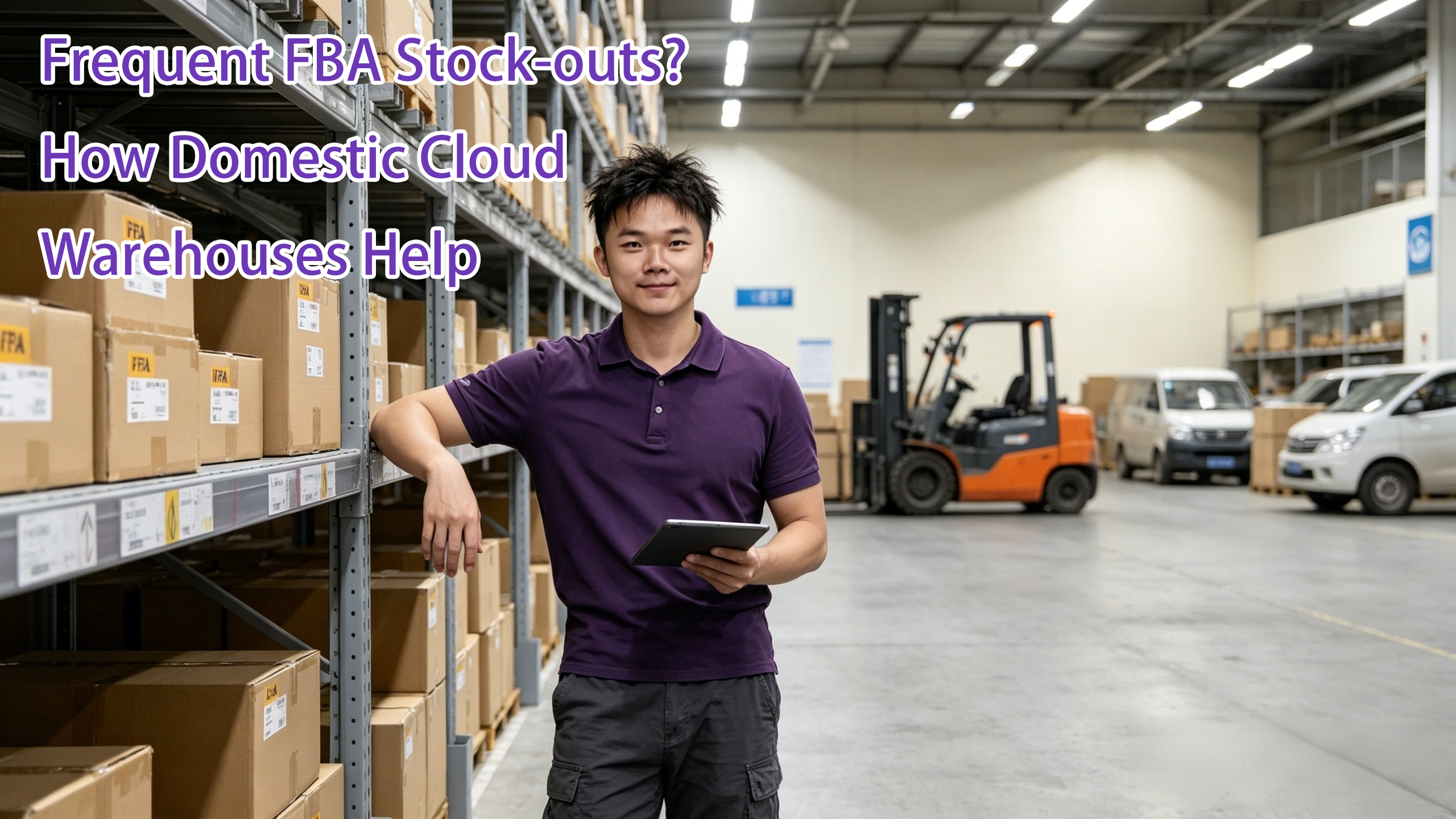
During peak season, activity period, and explosive growth stage, FBA inventory often decreases faster than the replenishment cycle, and the risk of stockouts will repeatedly occur. A more practical approach is to use domestic cloud warehouses as buffer warehouses for FBA inventory.
After the production of the goods is completed, it is not necessary to send them all at once to the Amazon warehouse. Instead, the goods should be stored in the domestic cloud warehouse first, and the first leg transportation should be arranged in batches according to the sales speed, FBA existing inventory, and warehouse capacity.
1:Why is it easy for FBA to run out of stock despite having inventory?
FBA replenishment should not only consider the current inventory quantity, but also the daily sales speed and first mile transportation cycle.
A household goods seller consistently sells 150 items per day, leaving 4500 items in the FBA warehouse, which looks like they can still sell for another month. But if the first leg of sea freight takes 20 to 30 days, plus the waiting time for FBA warehousing, the actual time available for replenishment is already limited.
If there is a promotion at this time and the daily sales increase from 150 pieces to 250 pieces, the inventory consumption rate will significantly accelerate. Waiting for the seller to detect inventory warnings and then arranging production, packing, and booking from the factory can easily lead to stockouts when restocking.
FBA inventory management should not only consider how many items are still available, but also take into account daily sales volume, in transit inventory, domestic spot inventory, and FBA sellable inventory to make a judgment.
2:Why is domestic cloud warehouse suitable for FBA replenishment buffer?
One practical use of domestic cloud warehouses is to allow sellers to avoid sending all their inventory to FBA at once.
After the first batch of FBA warehousing is completed, the cloud warehouse will continue to retain the remaining inventory. Wait for Amazon's warehouse capacity to be released or for FBA inventory to drop to the preset level before arranging the second batch of shipments.
The advantage of doing so is that the seller always has a portion of goods that can be adjusted. When FBA inventory is insufficient, it can be replenished, and when the platform warehouse is temporarily unable to receive goods, there is no need to stack the goods in the factory and repeatedly transport them.
3:How to arrange FBA replenishment in batches?
The first step is to send the entire batch of goods to the domestic cloud warehouse after the factory completes production, complete quantity verification, SKU registration, and outer box sorting.
The second step is to determine the first batch of replenishment quantities based on FBA's existing inventory and recent sales. For example, if 200 items are sold per day and there are still 3000 items available in FBA inventory, the next batch of goods can be arranged based on the first leg transportation cycle, rather than waiting until the inventory reaches its bottom before proceeding.
The third step is to label, pack, and release the first batch of goods according to FBA requirements, and then choose a suitable first mile logistics method for transportation.
The fourth step is to continue storing the remaining goods in the domestic warehouse. After the first batch of goods enters FBA, the second and third batches will be determined based on changes in sales volume and warehouse capacity.
Sudden increase in sales can lead to an early increase in replenishment volume. Sales are lower than expected, and there will be no need to put a large amount of inventory on FBA due to sending too much at once.
4:How to match FBA first leg to avoid getting stuck in the transportation process?
What FBA replenishment really needs to control is the entire cycle, not just the logistics quotation. A more prudent approach is to arrange different shipping rhythms based on the urgency of inventory. Normal replenishment can be prepared in advance with suitable first leg channels for bulk transportation. When there is a significant shortage of inventory, a faster transportation method can be chosen for urgent goods.
Domestic cloud warehouses can play a buffering role in this step. The goods have been stored in advance, and when the logistics channel changes, it is only necessary to adjust the outbound batch and transportation method, without waiting for the factory to produce again.
5:What kind of seller is more suitable for this replenishment model?
For brand sellers, a portion of their inventory can also be stored in a domestic cloud warehouse before the launch of new products. After the first batch enters FBA, the subsequent quantity will be determined based on actual sales volume to avoid the long-term occupation of FBA storage by a large amount of inventory due to unexpected sales of new products.
Taijia Cloud Warehouse can combine warehousing and management, FBA labeling, FBA packing, order processing, and multiple international logistics channels to provide sellers with warehouse and distribution connections from domestic stocking to end-to-end shipping. For SKUs that require frequent restocking, inventory can be stocked in advance, and subsequent shipments can be arranged in batches based on FBA warehouse capacity and sales situation.
What FBA inventory management really needs to solve is not how much goods are stored in the warehouse, but when the goods should be released, how much should be sent, and what method should be used, always leaving room for adjustment.
FAQ
Question: Can FBA still stock up in advance due to insufficient storage capacity?
Answer: You can first store the goods in a domestic cloud warehouse and wait for the warehouse capacity to be suitable before wholesaling them to FBA.
Question: Why can't FBA restocking be completed all at once?
Answer: Both sales volume and warehouse capacity may change, and sending too many items at once may result in inventory backlog or limited warehousing.
Question: Can domestic cloud warehouses directly do FBA first leg?
Answer: Labeling and packing can be completed according to FBA shipment requirements, and corresponding first mile logistics channels can be arranged.
SERVICE
Copyright © 2026 TakeSendShip. All rights reserved


