

The most easily overlooked factor for foreign trade factories after receiving overseas orders is the shipping cost. The order amount may only be a few thousand yuan, and the quantity of goods is only a few boxes, but the destinations may be scattered in multiple markets such as Germany, the United Kingdom, the United States, and Canada. Every time an order comes, we search for goods from the factory, pack them, and contact logistics. The more orders there are, the busier the warehouse becomes.
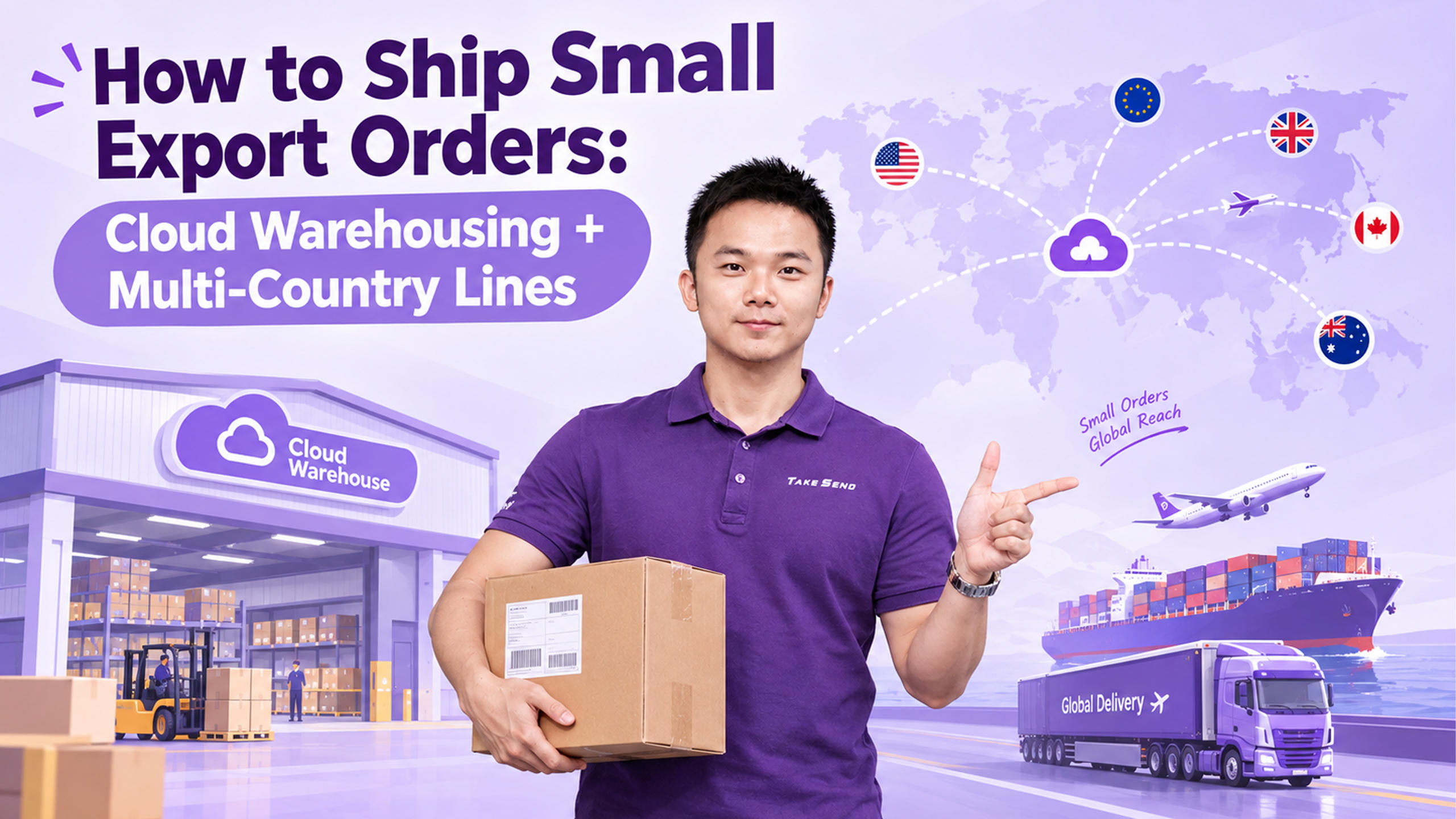
For this type of business, it is more suitable to hand over the finished product inventory to cross-border cloud warehouses for outsourcing in advance, and then release it in batches according to customer orders for scattered external orders.
The goods are stored centrally first, and after the order is confirmed, the corresponding international logistics channel is selected according to the destination. The factory does not need to arrange shipments around several cardboard boxes every day.
1:Why are foreign trade orders increasingly testing factory warehouses
Large scale orders have fixed shipping plans, while scattered small orders are difficult to form a unified rhythm. Today we will send two boxes, tomorrow we will send one box, and the day after tomorrow we will need to replenish a few samples. The warehouse staff keeps searching and packaging the goods repeatedly.
If a factory produces dozens of products simultaneously, inventory may also be scattered across different workshops. After receiving the overseas order, the salesperson needs to reconfirm the inventory location and coordinate with the warehouse to arrange shipment.
Transferring the completed production goods to the cloud warehouse can separate production and shipment. The factory is responsible for production, while the cloud warehouse is responsible for inventory management and subsequent outbound shipments. Orders are processed once they arrive, eliminating the need for the production warehouse to store goods waiting to be shipped for a long time.
2:What foreign trade orders are suitable for cloud warehouse managed inventory
Cloud warehouses are more suitable for foreign trade enterprises with unstable order frequency, multiple SKUs, and dispersed customer countries.
After the goods enter the warehouse, they can be managed according to SKU, batch, and quantity. The goods whose delivery date has not been confirmed by the customer will continue to be stored, and picking and packaging will be arranged after the shipment is confirmed.
For factory orders, this method can also reduce repetitive handling. When customers purchase in batches, there is no need to rearrange the goods from the production end every time. The warehouse will release the goods according to the order quantity, and the remaining inventory will continue to be stored.
If there is an increase in orders in the future, labeling, packaging replacement, order consolidation, and order forwarding can also be added according to demand, without the need to search for a new warehouse.
3:Why can't multiple countries use only one logistics for small orders
Foreign trade orders sent to different countries may have different weight, size, delivery time, and import requirements. It is difficult for one logistics channel to be suitable for all orders in the long run.
The transportation costs for the same ten kilogram cargo may differ between shipping to the United States and Europe. When customers are in a hurry to restock, their requirements for timeliness are also different from regular orders.
So scattered small orders are more suitable for selecting channels based on the destination. After the warehouse completes picking and packaging, corresponding international dedicated lines will be arranged according to the actual situation of the goods. This can avoid using the same shipping method for all orders.
There is a shipping detail that the factory should pay attention to. When inquiring, do not only provide the name of the goods, it is best to also provide the number of boxes, weight of each box, outer box size, and destination. Goods with larger volumes may be charged based on volumetric weight, and the final price may differ from the actual weight obtained by looking at it alone.
4:What problems is the tax inclusive international dedicated line suitable for solving
When some foreign trade orders are sent to the European and American markets, customers are more concerned about the taxes and delivery issues arising from the import process. Goods that meet the requirements of the channel can be considered for a tax inclusive international dedicated line.
However, including taxes does not mean that all goods and countries can directly use them. The attributes of the goods, declaration information, destination policies, and channel receiving requirements all need to be confirmed in advance.
If the factory ships to multiple countries for a long time, organizing common product information, weight, packaging size, and destination in advance will save a lot of redundant communication in subsequent inquiries and shipments.
5:How to connect cross-border cloud warehouses to multi country dedicated lines
For scattered foreign trade orders, Taijia Cloud Warehouse can first undertake domestic inventory custody. After the factory completes production, the goods are sent to the warehouse for receiving, counting, and inventory registration. After the order is confirmed, it will be sorted, packaged, and shipped out according to the customer's requirements.
If the order requires labeling, packaging replacement, consolidation, or other warehouse operations, it can also be increased according to actual needs. A warehouse is not just for inventory, but also for preparing orders before shipment.
The logistics department can choose multiple international dedicated lines of Taijia Logistics based on the destination and cargo situation. It has over a hundred international logistics dedicated channels, including tax inclusive international dedicated lines for different countries and cargo demands.
Foreign trade factories do not need to fix all orders in one way, and can freely choose according to the destination, weight, and delivery requirements of the batch of goods.
FAQ
Question: There are many small orders in foreign trade factories. Is it suitable to use cloud warehouses?
Answer: Suitable for factories with scattered orders, multiple SKUs, and a wide distribution of overseas customers.
Question: Can cloud warehouses only manage inventory?
Answer: Yes, according to actual needs, we can choose warehouse custody or add operations such as order forwarding.
Question: Is it possible to freely choose logistics for orders from multiple countries?
Answer: You can choose the corresponding channel based on the destination, cargo attributes, weight, and delivery time.
SERVICE
Copyright © 2026 TakeSendShip. All rights reserved


