

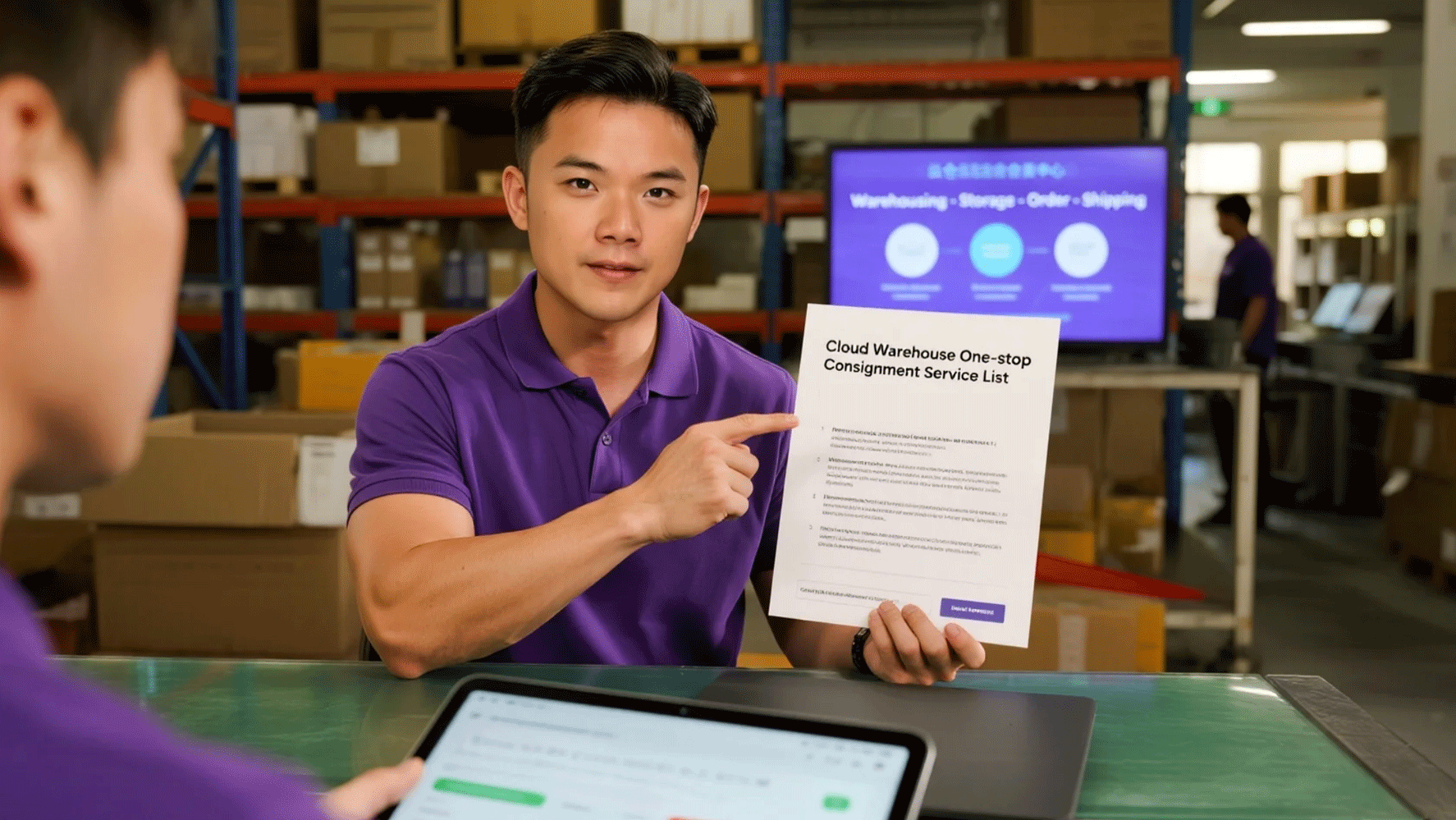
Many cross-border traders hear the term "cloud warehouse one-stop consignment" when expanding their business, but not many truly understand its meaning and operation mode.
For cross-border e-commerce sellers who need to frequently stock, distribute, and manage multiple sales platforms, what benefits can cloud warehouse one-stop consignment bring, and is it suitable for their business model, is the key to deciding whether to adopt this service.
From the surface, cloud warehouse is an intelligent warehousing service model. Sellers do not need to build their own warehouses; they only need to store goods in advance at a third-party warehouse, and then manage the inventory and orders through an online system. The warehouse can complete the shipping operation on behalf of the seller.
One-stop consignment means that when an order comes in, regardless of the quantity, even if it's just one item, the warehouse will package, label, and hand it over to the carrier for delivery. This model is particularly suitable for cross-border traders. It not only solves the problems of scattered inventory and slow overseas logistics, but also significantly reduces storage and labor costs.
Many sellers may not be clear about its operation process. Specifically, the process of cloud warehouse one-stop consignment is as follows:
First: Sellers deliver goods to the designated warehouse of the cloud warehouse through domestic logistics or headhaul transportation. After the goods are warehoused, the inventory information will be automatically synchronized to the system, and sellers can check the inventory quantity and status at any time.
Second: When a customer places an order on the platform, the order information will be automatically transmitted to the warehouse system. The warehouse will perform picking, quality inspection, packaging, and label printing according to the order requirements, and then hand it over to the logistics company for delivery. The entire process does not require sellers to operate personally. Sellers only need to check the order delivery status through the backend to achieve full-process visual management.
For cross-border traders, the significance of cloud warehouse one-stop consignment lies not only in having someone handle the shipping, but also in optimizing the supply chain structure.
In the past, many small and medium-sized sellers, due to the lack of local warehouses, had to choose to directly ship goods to overseas customers from China. This model not only had slow transportation efficiency but also easily led to high return costs and expensive logistics fees.
Now with cloud warehouse one-stop consignment, sellers can first transport goods to the cloud warehouse and use centralized storage to reduce the headhaul cost. Then, through local warehouses, they can achieve rapid delivery. The overall experience is closer to that of local e-commerce.
For example, Taigayun Warehouse provides such one-stop consignment services, covering the entire process from warehousing inspection, free storage, order picking, packaging, labeling to delivery, helping cross-border traders directly transport domestic goods to overseas warehouses and then deliver them locally.
This model not only shortens the delivery time for overseas customers but also reduces the daily cumbersome logistics coordination and manual operation pressure for sellers.
Whether it's Amazon, eBay, or independent website orders, the system can manage them uniformly, avoiding the error rate when handling orders manually.
By making reasonable use of the free storage period of cloud warehouse and automated operations, sellers can reduce storage and labor costs while focusing on more valuable aspects such as product selection and marketing.
SERVICE
Copyright © 2026 TakeSendShip. All rights reserved


